

CFP® Certification General FAQs
What is a CFP®?
CFP refers to CERTIFIED FINANCIAL PLANNER® It’s the premier credential for financial planners and is governed by CFP Board. CFP® professionals have proven proficiency in all areas of financial planning, including: general financial planning, tax, estate, investments, insurance and risk, and retirement, as well as the psychology of financial planning. CFP®professionals must also uphold strict ethics and maintain their credential through continuing education.
Learn more: Everything Guide to CFP® Certification
How do I become a CFP® Professional?
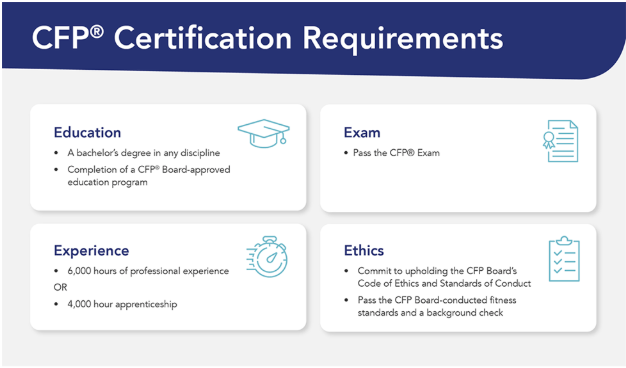
CFP Board requires “The 4E’s,” which stand for education, exam, experience, and ethics.
- Education: Hold a bachelor’s degree and complete a CFP Board-registered coursework program, ending in a Capstone course
- Exam: Pass the 170-question CFP® Exam
- Experience: Complete either 6,000 hours of relevant experience or 4,000 hours in a supervised apprenticeship
- Ethics: Pass a background check and sign a document to adhere to CFP Board’s Code of Ethics and Standards of Conduct
Learn more: How to Become a CFP® Professional
Do I Need a Bachelor’s Degree to Become a CFP® Professional?
Yes, you must complete a bachelor’s degree from an accredited university within five years of passing the CFP® Exam. Your degree does not need to be in a business or finance-related topic and can be in any area.
How Long Does It Take to Become a CFP® Professional?
It depends on factors like prior experience and education and how quickly you can complete the coursework and pass the exam. Most people complete their requirements in 18 to 24 months, though BIF is designed for students to complete their coursework and pass the exam in less than a year!
Why Should I Pursue CFP® Certification?
CFP® certification is seen as the “gold standard” in financial planning, so holding this credential proves you have advanced knowledge and skills. More clients and employers seek credentialed financial planners, and this opens more doors to career growth and a higher earning potential.
But the greatest benefit to CFP® certification is that it makes you a better financial planner! You gain in-depth knowledge of individual areas, but you also learn how to put the pieces together while tailoring them directly to your clients’ unique needs.
Learn more: The Benefits of CFP® Certification
What’s the Difference Between a CFA® and CFP® Professional?
Chartered Financial Advisors are recognized by the CFA Institute as having proven competence in investment and financial analysis and focus more on the data side of finance. CERTIFIED FINANCIAL PLANNER® professionals are recognized by CFP Board as having proven competence in all areas of financial planning, including estate, tax, and investments. They focus more on working with clients to help them meet their goals through personalized financial plans.
What Is the CFP® Experience Requirement?
There are two ways to fulfill the CFP® experience requirement:
- Complete 6,000 hours of relevant professional experience.
- Complete 4,000 hours of an apprenticeship supervised by an active CFP® professional.
- Understanding the Client’s Personal and Financial Circumstances
- Identifying and Selecting Goals
- Analyzing the Client’s Current Course of Action and Potential Alternative Course(s) of Action
- Developing the Financial Planning Recommendation(s)
- Presenting the Financial Planning Recommendation(s)
- Implementing the Financial Planning Recommendation(s)
- Monitoring Progress and Updating
- Personal engagement with clients
- Support of financial planner and/or financial planning process
- Supervision of financial planner and/or financial planning process
- Internship or Financial Planning Association (FPA) residency
- Instruction of post-secondary financial planning courses
To meet the 6,000 hour requirement, your professional experience must include ONE of the following tasks:
However, to meet the 4,000-hour requirement, your work must include all the seven primary areas of the personal finance process listed above.
And all candidates must earn this experience through ONE of these methods:
Your experience requirement must be complete within 10 years prior to or five years after passing the CFP® Exam.
CFP® Education FAQs
What Is the CFP® Education Requirement?
CFP requires candidates to complete a board-registered coursework program that covers the eight principal knowledge topics in seven courses:
- General Principles of Financial Planning
- Professional Conduct and Regulation
- Risk Management and Insurance Planning
- Investment Planning
- Tax Planning
- Retirement Savings and Income Planning
- Estate Planning
- Psychology of Financial Planning
Upon completing the seven required courses, candidates must complete a Capstone course. The Capstone is a practical project with case studies and client scenarios where candidates can prove they understand and know how to apply their knowledge in real-world situations.
Can I Skip the CFP® Education Coursework?
Do you have one of these advanced degrees or designations?
- Certified Public Accountant (CPA)
- Chartered Financial Analyst®( CFA®)
- Chartered Life Underwriter (CLU) or Chartered Financial Consultant (ChFC)
- Ph.D. in Financial Planning, Finance, Business Administration, or Economics
- Licensed Attorney
- International CFP<sup>®</sup> Certification
If yes, you may be able to meet bypass the coursework and only complete the Capstone course to show your understanding of the principal knowledge topics. The BIF Student Advisors can help you determine if you’re eligible, but CFP Board has to give approval.
Learn more: Taking the Accelerated Path to CFP® Certification
CFP® Exam FAQs
What Is the CFP® Exam?
It’s a comprehensive exam that tests your knowledge of eight financial planning topics in a variety of scenarios. There are 170 multiple-choice questions, and you have six hours to complete the exam.
Learn more: Everything Guide to CFP® Certification Exam
What Is on the CFP® Exam?
You’re tested on eight principal knowledge topics. Questions on retirement savings and income planning are the most heavily represented, and the psychology of financial planning is the least represented topic.
Here’s a breakdown of the topics and how much of the exam is devoted to each one.
- Professional Conduct and Regulation (8%)
- General Principles of Financial Planning (15%)
- Risk Management and Insurance Planning (11%)
- Investment Planning (17%)
- Tax Planning (14%)
- Retirement Savings and Income Planning (18%)
- Estate Planning (10%)
- Psychology of Financial Planning (7%)
When Are the CFP® Exam Testing Windows?
CFP Board has three testing windows each year in March, July, and November. In 2026, the CFP Exam will be offered:
- March 17–24, 2026
- July 14–21, 2026
- October 29–November 5, 2026
Learn more: 2026 CFP® Exam Dates and Deadlines
How Much Does the CFP® Exam Cost?
Depending on when you register, the exam fees cost between $825 to $1,025.
- Early Bird Registration ($825): This pricing is available from the day registration opens until six weeks before the final registration deadline.
- Standard Registration ($925): This kicks in after the early bird period ends but before the final week of registration.
- Late Registration ($1,025): Registering during the last open week is going to cost you, but it still beats having to wait another four months to take the exam.
How Do I Register for the CFP® Exam?
If you’ve already had your coursework approved and have the go-ahead to sit for the exam, go to your CFP Board account dashboard. In the exam section, click Select Your Test Dates, complete the form, and pay the registration fee.
- In your dashboard’s Exam section, click Select Your Test Dates and complete the form.
- Pay the registration fee.
- Check your email with a confirmation and a link to the Prometric website where you can schedule your exam day and time.
Where Do I Take the CFP® Exam?
You can schedule your exam at any Prometric Center. However, we recommend doing so as soon as possible once the registration windows are open so you can secure your preferred location and time.
Learn more: Six Hours to Success: CFP® Exam Day
What Is Taking the CFP® Exam Like?
The six-hour, 170-question exam is an all day event. The video below walks you through what you can expect.
What Is the CFP® Exam Pass Rate?
It varies between each testing cohort, but it’s usually between 60 and 65%.
Students in The BIF Review who pass our Mock Exam have a 90% pass rate on the CFP® Exam!
Learn more: How Hard Is the CFP® Exam

How Many Times Can I Take the CFP® Exam?
You only have five attempts total to pass the exam, and each time, you need to pay the exam fee.
By using the BIF Review, you’ll increase your chance of passing the first time, reducing your overall costs by minimizing your re-take fees. Students who pass the BIF Review’s Mock Exam have a 90% pass rate on the CFP® Exam!
What Score Do I Need to Pass the CFP® Exam?
Bryant CFP® Instructor and Practicing Financial Planner
The CFP® Certification Exam is graded as either pass or fail, and each question is worth one point. However, there isn’t a fixed passing score.
Instead, Prometric and the CFP Board use a method called “Modified Angoff Scoring” to set the passing mark. Experts review each question and estimate the percentage of competent CFP<sup>®</sup>professionals who would answer it correctly. These percentages are combined and adjusted to determine the official passing score for that exam.